Customer Identity Verification: What Businesses Need to Know

Every time a new customer signs up for your service, you need to check who this person is and whether or not you can trust them. In the physical world, you can just ask and decide. But, in the digital world, it takes a whole system.
Customer Identity Verification (IDV) is the process of confirming that a person is who they claim to be, typically performed during account opening, onboarding, or during a high-stakes transaction. Combining technology, data, and regulatory compliance, the IDV process is set to help businesses make confident decisions about who they’re doing business with.
In this article, we explore the core principles of customer identity verification, examine why it is a critical component of modern business strategy, and outline actionable best practices to help your organization balance strong security with a frictionless user experience.
How Customer Identity Verification Works
Depending on your industry or platform type, the customer identity verification process might look different, but the underlying logic is the same: collect information, validate it, confirm the person’s identity, assess risk, and make a decision.
What you need from the customer is their name, date of birth, address, and a valid ID. That data is then run through a series of automated checks. So, an IDV system looks at whether the document is genuine, whether the person’s face matches the document photo, and whether the data is supported by the external databases. And, finally, a risk assessment determines whether the application is approved, flagged for manual review, or rejected.
Nowadays, all these steps happen in seconds, as the best modern identity verification systems are automated. So, it’s the quality of that automation that separates a trustworthy onboarding experience from one that either lets bad actors through or frustrates legitimate customers.
Types of Customer Identity Verification
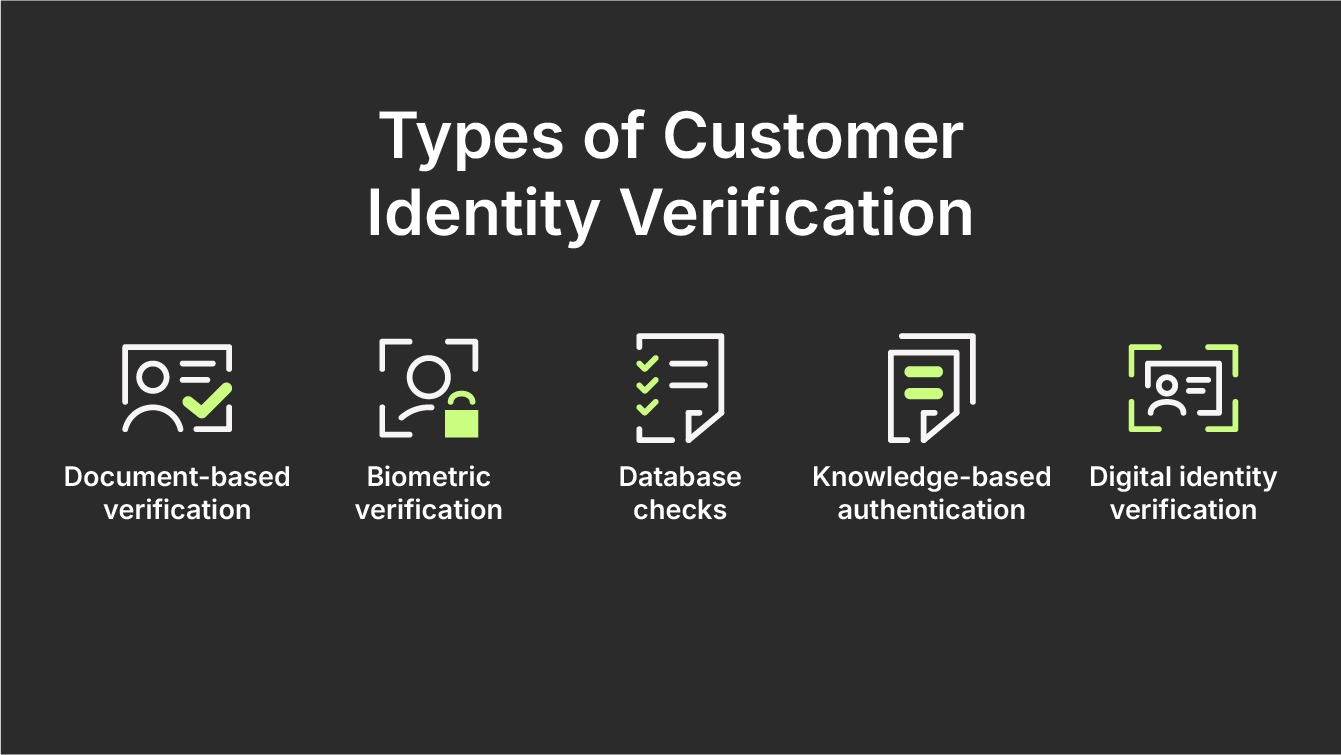
There’s no single method that works for every use case, and businesses typically combine several approaches depending on the level of assurance they need. Let’s review the main identity verification approaches:
- Document-based verification checks the authenticity of government-issued IDs, such as passports, driver’s licenses, national ID cards, by analyzing security features, holograms, and machine-readable zones.
- Biometric verification uses a person’s unique physical characteristics, such as facial geometry, to confirm they match the identity document they’ve submitted.
- Database checks cross-reference a customer’s information against credit bureaus, government registers, sanctions lists, and watchlists to verify their existence and identify potential risks.
- Knowledge-based authentication (KBA) asks customers to answer questions only they should know, such as previous addresses or account details.
- Digital identity verification uses electronic identity systems, such as government-issued digital IDs or bank-verified credentials, to confirm identity without physical documents.
Why Customer Identity Verification Matters for Businesses
The most obvious reason why customer IDV matters is fraud prevention, because when you verify who your customers are, you significantly reduce the likelihood of account takeovers, synthetic identity fraud, and unauthorized account creation.
Here are the other benefits that businesses experience when they verify their customers’ identities:
Regulatory compliance. From fintech and banking to healthcare and gambling, across most industries in fact, identity verification is a legal obligation. Failing to comply is not risky and expensive. Fines, license revocations, and reputational damage are all very real consequences.
Customer trust. When customers know you take their security seriously, they’re more likely to stay. A verified platform signals professionalism and accountability.
Scalable onboarding. Manual identity checks don’t scale well, while automated verification lets you digitally onboard hundreds or thousands of customers simultaneously without adding headcount.
Global reach. A solid identity verification process means you can accept customers from multiple countries with confidence, rather than limiting your market to avoid uncertainty.
EXAMPLE: A bank that skips identity verification might onboard faster in the short term, but one fraudulent account can trigger regulatory checks, financial losses, and months of damage control. So, it’s less hassle to get it right from the start.
Legal and Regulatory Considerations
Rules can often feel overwhelming, but they are necessary, as they help you achieve two important goals: prevent crime and protect your customers’ privacy.
Regulations vary by geography, sector, and risk profile. But one thing is constant: identity verification requirements are expanding, not contracting.
The main ones are Know Your Customer (KYC) and Anti-Money Laundering (AML) requirements. They are the backbone of identity verification for financial services.
Global: AML and CFT (Countering the Financing of Terrorism) standards are set by the Financial Action Task Force (FATF), which requires financial institutions to identify and verify their customers using reliable, independent sources before establishing a business relationship. In particular, FATF Recommendation 10 mandates Customer Due Diligence (CDD), prohibits anonymous accounts, and demands ongoing monitoring of business relationships.
The United States: The Bank Secrecy Act (BSA), administered by FinCEN, requires covered financial institutions to implement Customer Identification Programs (CIPs). Under the USA PATRIOT Act, this includes verifying the identity of anyone seeking to open an account and maintaining records of the information used to do so.
Europe: The General Data Protection Regulation (GDPR) governs how personal data is collected and processed during identity verification in the EU and the UK. GDPR Recital 64 states that controllers must use “all reasonable measures” to verify a data subject’s identity, particularly in online contexts, while Article 5(1)(c) requires that data collection be limited to what is strictly necessary.
But what about the industries beyond financial services? They have their own rules:
- Age verification requirements are now common in online gambling and adult content platforms.
- Meanwhile, healthcare platforms must meet HIPAA standards.
- Crypto and virtual asset businesses face their own AML obligations.
Key Steps in the Customer Identity Verification Process
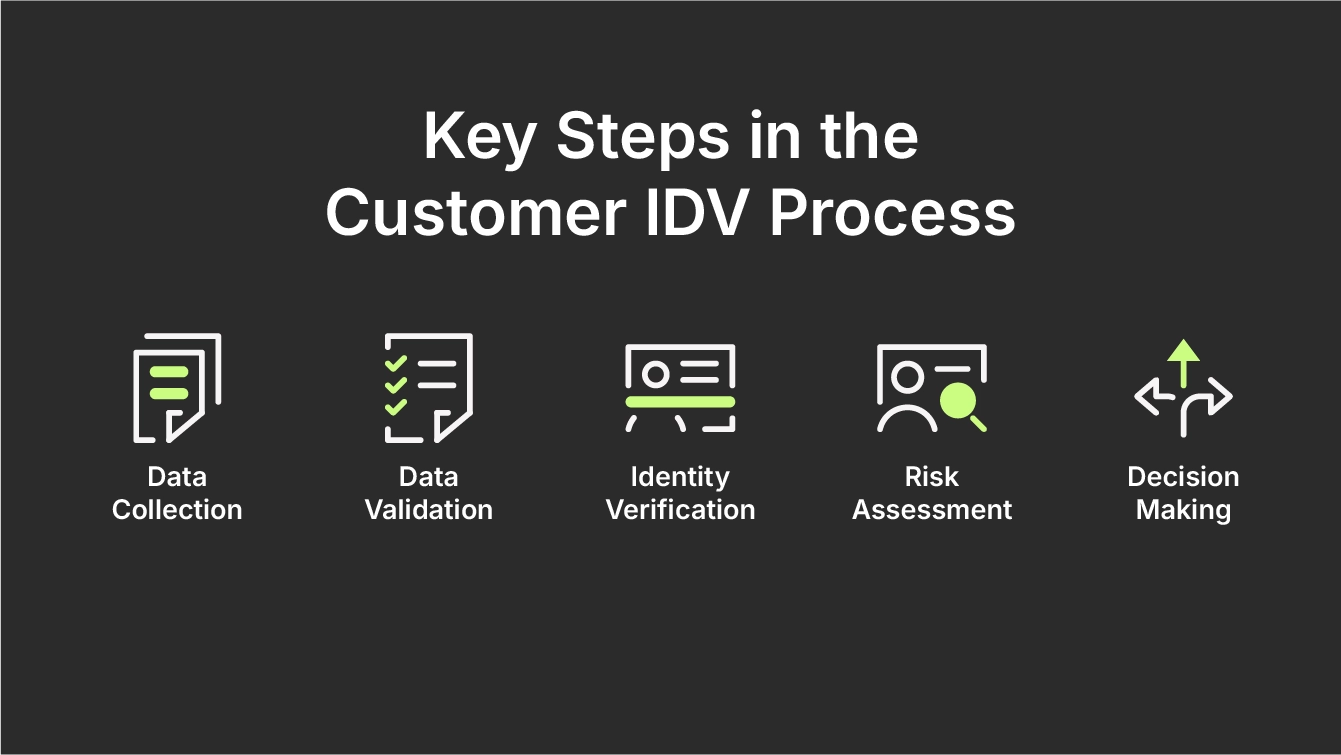
The customer verification process consists of a few steps, and ideally, it should be frictionless, automated, and easy.
Data Collection
You gather the basic info: full name, date of birth, address, and identity document details. Accuracy is key, as a clear, well-guided input stage means fewer frustrations later on. Even small discrepancies, like a misspelled name or a transposed digit, can cause false rejections or open the door to fraud. A well-designed data collection flow prompts users clearly and minimizes entry errors.
Data Validation
Before diving deep, the system checks the basics. Does the address look real? Is the document type/ format correct for that country? Are the data fields in the expected format? Does the document appear unaltered? This step catches obvious errors and anomalies early, saving time and reducing costs.
Identity Verification
At this stage, the system checks whether the identity document is genuine, whether the person presenting it actually matches the document, and whether the identity exists in authoritative records. Depending on risk level, this may involve document scanning, biometric comparison, or database lookups, or all three at once.
Risk Assessment
The system assesses risk by looking for “red flags,” such as an IP address that doesn’t match the user’s provided location, which might suggest a need for a second look. This step evaluates such signals as unusual locations, mismatched data, watchlist hits, or behavioral patterns. A first-time customer from a low-risk country with a clean document looks very different from someone who appears on an international sanctions list.
Decision Making
Finally, the system makes a choice: approve, reject, or escalate for manual review. In automated systems, this decision is based on predefined rules and risk thresholds. Most businesses configure their systems to approve clean cases instantly, while flagged cases are queued for human review, and customers receive clear communication about the outcome.
Common Customer Identity Verification Methods
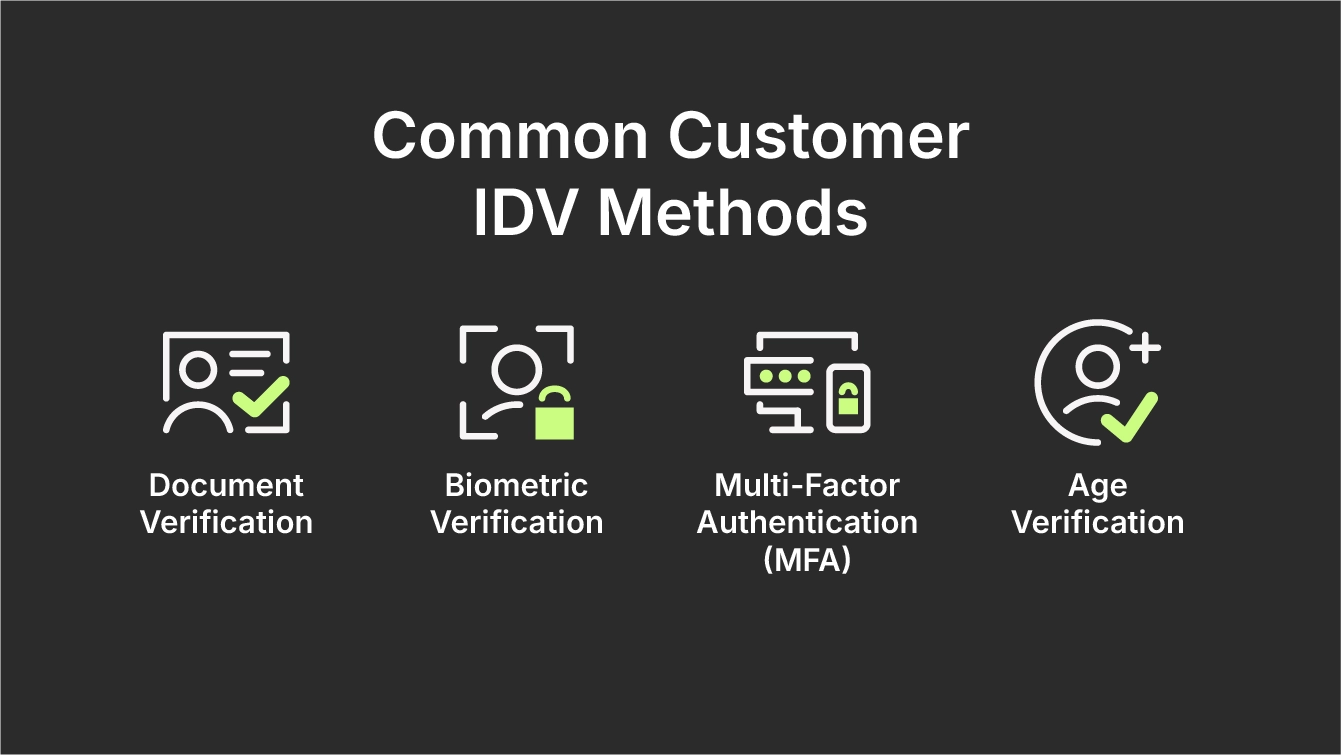
Depending on use case specifics and the nature of the business relationship, organizations use different IDV methods to make sure their customers are who they say they are.
Document Verification
As the method’s name suggests, we check an identity document. A customer uploads a photo of their passport or driver’s license. Then, the system uses optical character recognition (OCR) to extract the information and analyzes such security features as holograms, microprinting, and MRZ codes, to confirm the document is authentic and unaltered. Advanced IDV systems can detect digitally manipulated images and compare documents against thousands of known formats from around the world.
Biometric Verification
After submitting their document, a customer takes a selfie or short video. The system compares their face to the photo on the ID using facial recognition technology. This involves a liveness check to confirm that the person is real, during which the system checks that the person is physically present and not using a still image or mask. Without it, a fraudster could simply hold up a printed photo.
Multi-Factor Authentication (MFA)
MFA adds an additional “just in case” layer, beyond a single check. A customer might verify their document, then confirm a code sent to their phone, then pass a biometric check. Each factor makes the overall process more secure, because even if one method is compromised, others remain in place. MFA is increasingly standard for high-risk transactions, sensitive account changes, or re-authentication scenarios.
Age Verification
Essential for industries like gaming, gambling, alcohol or tobacco e-commerce, adult content platforms, these checks make sure you’re staying on the right side of the law when it comes to age-restricted content or products.
Age verification can be achieved through document review, biometric analysis, or database cross-referencing. For example, an online gaming platform might require a user to upload their driver’s license before allowing them to deposit funds, not just to confirm identity, but to confirm they’re above the legal gambling age in their jurisdiction.
Challenges in Customer Identity Verification
The biggest challenge for most businesses is known as the “Goldilocks” problem: you need to be secure enough to stop the bad guys, but frictionless enough that you don’t annoy your good customers. So, if the verification process takes too long or asks for too much, conversion rates suffer. The user friction challenge is building security that doesn’t feel like a punishment.
The next problem manifests itself in an increasingly sophisticated fraud. The new kid on the block is synthetic identity fraud, where criminals combine real and fake data to create a new identity, and it’s particularly hard to detect. Deepfake technology is also making it easier to fool biometric systems that lack robust liveness detection.
Regulatory complexity is our next culprit. A business operating across multiple jurisdictions must navigate different KYC rules, data protection laws, and document standards. What’s compliant in one country may not be in another, and the rules constantly change.
Finally, it’s the pestering challenge of having too many false positives. When systems are too strict, they reject valid customers. Often, those people have non-Western names, expired documents, or documents from less common countries. Apart from being just a UX problem, it’s also an equity issue that can expose businesses to discrimination complaints and, as a result, lost revenue.
Implementing Customer Identity Verification and Best Practices
When it comes to implementation, don’t try to do everything at once. Pick a solution that grows with you, starting with the essentials and adding “step-up” checks, where you ask for more info only when a transaction seems high-risk.
Map out your compliance requirements: define which regulations apply to your industry, geography, and customer base. Then define what level of assurance you need for different user journeys. For example, onboarding a retail banking customer carries different risk than signing up a newsletter subscriber.
When choosing an identity verification solution, look for coverage of the document types and countries relevant to your users, clear audit trails for compliance purposes, API flexibility to fit into your existing tech stack, and a vendor with a track record of keeping pace with evolving regulatory requirements.
It’s important to involve legal, compliance, product, and engineering teams early. Identity verification isn’t just a technical implementation, because it affects customer experience, risk management, and your regulatory obligations, too.
Best Identity Verification Practices
Reduce friction without reducing security. Use progressive verification, which means: start with the minimum required, and only ask for more if risk signals warrant it. A low-risk customer buying a €10 product doesn’t need the same scrutiny as someone opening an account at a financial institution.
Design for accessibility. Not everyone has a smartphone with a high-quality camera or a government-issued ID in a standard format. Make sure your verification flow accommodates a range of users, devices, and document types. Most of your users are on their phones; make sure the interface works perfectly on any screen.
Keep records. Most compliance frameworks require you to retain identity verification data for a specified period (FATF recommends at least five years). Build this into your system design from the start.
Monitor continuously. Keep watching for changes in customer behavior, new fraud patterns, and regulatory updates. Review your false positive and false negative rates regularly and adjust thresholds accordingly.
Keep it human. If a user makes a mistake, give them clear, friendly instructions. For example: “The lighting is a bit dark on that ID.”
Test and learn. Use A/B testing to see how your users interact with your forms and refine them to keep abandonment low.

How Ondato Supports Customer Identity Verification
Understanding what customer identity verification requires is one thing. But building it reliably, at scale, and across jurisdictions is another challenge entirely.
Ondato takes the stress out of compliance and identity verification. Our platform is built to automate the heavy lifting: integrating document checks, biometric data, and anti-money laundering workflows into one seamless experience. Whether you’re onboarding individual customers or verifying business entities, Ondato brings together the tools to do it accurately and efficiently.
For individual customers. Ondato handles document verification across thousands of ID types from countries worldwide, biometric matching and liveness detection, database checks against sanctions lists and Politically Exposed Persons (PEPs), and age verification for regulated industries.
For businesses. Ondato’s Know Your Business (KYB) workflows verify company ownership structures, Ultimate Beneficial Owners (UBOs), and corporate documents – so you’re not just verifying who a person is, but who stands behind the business they represent.
The entire onboarding journey can be configured to match your compliance requirements: whether that means a lightweight KYC flow for lower-risk use cases or Enhanced Due Diligence (EDD) with multi-step verification for high-risk customers. Automation handles the routine cases, while human review tools support the complex ones.
For businesses operating across borders. Ondato’s platform is designed to adapt to local regulatory requirements without requiring you to rebuild your process for every market. The result is an onboarding experience that protects your business, keeps regulators satisfied, and gives legitimate customers a smooth path forward without the friction that drives them away.
FAQ